MrMCar
Active member
- Joined
- Apr 26, 2024
- Messages
- 283
- Reaction score
- 141
- Points
- 43
I'll attempt to explain the operation of the "Coupler" and what goes wrong/right and why it makes noise on acceleration from a stop at turns.
Disclaimer: Whilst I'm a retired BMW Master Technician and ASE certified, I have not had hands on with the below product. Rather I've spoken with colleagues and have a good feel for the operation of the Coupler and what goes wrong?
I'll use some pictures I've pulled off of the internet and try to explain the function of the coupler, attached to the front part of the rear differential.
If you choose to, read on. And I'm not above criticism, if applicable. There's a saying in my business; "Always Learning."
It's similar albeit, different from the BMW's I've worked on most of my life. It's actually a bit more ingenious than BMW's system IMO.
The Kia (Hyundai) is primarily a Front Wheel Drive (FWD) vehicle. Whereas, the BMW is the reverse. The drivetrain is laid out with the engine in typical east/west configuration and the power being sent mostly to the front axle. Unless you drive like the proverbial 90 year old, a portion of the power being applied to the road is sent unto the rear axle. Surprisingly quite a bit. If you had a scan tool in your hand and watched "live data" you'd see anything from 15% to 45% of the drivetrain's power being sent to the rear axle, almost all of the time. This happens unbeknownst to the driver. Both as an aid and to lessen all of the torque being sent to the front axle ONLY. (BMW does this in reverse, being mostly a RWD vehicle.)
This comes about rather simply, the rear driveshaft always spins. Albeit w/o any connection, freewheels so to speak. The "Coupler" has an electric motor, akin to a windshield wiper motor. This rotates a an internal gear and applies some small clutches (think transmission friction clutches) inside the coupler that will now send power to the rear differential and share the load: Send some of the engines power through the rear axle.
This lessens the load on the front tires and distributes power to the ground more evenly.
This in turn, lessens the possibility of front wheel spin (traction control intervening) by shedding some of the load to the rear of the vehicle.
Also VERY useful during adverse traction events like ICE and SNOW. Shed the load to both axles, not just one. Two wheels grip better than one (both differentials are NOT limited slip) one in the front, the other in the rear.
Complete rear differential:.

Here's where things go awry;
There's an electric motor that on demand (anti slip system, which is always working) ramps up current to the little black motor on the coupler and starts to apply the clutches. This brings online the rear differential and applies torque to the rear wheels. In doing so, shares the load to the rear axle. Problem is that the clutches bang (constant on/off cycles) and the torque (power) is interrupted on, then off and on again over and over very fast. Think: applying on/off the clutch pedal in rapid succession. This produces a banging as the power is applied and released very quickly. There's a problem internally with the motor and the friction clutches (BMW had this also with many transfer cases which operate the same) that produce this banging sensation. Replacing the coupler (attached to the front of the differential, as a sort of on/off switch) with the updated part, solves the issue.
Coupler:
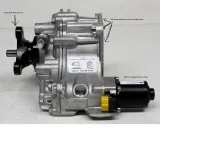 So it's the front half of the differential (used part in photo 1) that gets replaced with the new part (second picture) along with three new driveshaft bolts. This solves the banging noise (often mis-diagnosed as a rear shock) when taking off from a stop and going around the corner.
Please excuse the poor photos and "paint" altered photos. I'm away from my familiar desktop computer.
HTH someone?
Disclaimer: Whilst I'm a retired BMW Master Technician and ASE certified, I have not had hands on with the below product. Rather I've spoken with colleagues and have a good feel for the operation of the Coupler and what goes wrong?
I'll use some pictures I've pulled off of the internet and try to explain the function of the coupler, attached to the front part of the rear differential.
If you choose to, read on. And I'm not above criticism, if applicable. There's a saying in my business; "Always Learning."
It's similar albeit, different from the BMW's I've worked on most of my life. It's actually a bit more ingenious than BMW's system IMO.
The Kia (Hyundai) is primarily a Front Wheel Drive (FWD) vehicle. Whereas, the BMW is the reverse. The drivetrain is laid out with the engine in typical east/west configuration and the power being sent mostly to the front axle. Unless you drive like the proverbial 90 year old, a portion of the power being applied to the road is sent unto the rear axle. Surprisingly quite a bit. If you had a scan tool in your hand and watched "live data" you'd see anything from 15% to 45% of the drivetrain's power being sent to the rear axle, almost all of the time. This happens unbeknownst to the driver. Both as an aid and to lessen all of the torque being sent to the front axle ONLY. (BMW does this in reverse, being mostly a RWD vehicle.)
This comes about rather simply, the rear driveshaft always spins. Albeit w/o any connection, freewheels so to speak. The "Coupler" has an electric motor, akin to a windshield wiper motor. This rotates a an internal gear and applies some small clutches (think transmission friction clutches) inside the coupler that will now send power to the rear differential and share the load: Send some of the engines power through the rear axle.
This lessens the load on the front tires and distributes power to the ground more evenly.
This in turn, lessens the possibility of front wheel spin (traction control intervening) by shedding some of the load to the rear of the vehicle.
Also VERY useful during adverse traction events like ICE and SNOW. Shed the load to both axles, not just one. Two wheels grip better than one (both differentials are NOT limited slip) one in the front, the other in the rear.
Complete rear differential:.
Here's where things go awry;
There's an electric motor that on demand (anti slip system, which is always working) ramps up current to the little black motor on the coupler and starts to apply the clutches. This brings online the rear differential and applies torque to the rear wheels. In doing so, shares the load to the rear axle. Problem is that the clutches bang (constant on/off cycles) and the torque (power) is interrupted on, then off and on again over and over very fast. Think: applying on/off the clutch pedal in rapid succession. This produces a banging as the power is applied and released very quickly. There's a problem internally with the motor and the friction clutches (BMW had this also with many transfer cases which operate the same) that produce this banging sensation. Replacing the coupler (attached to the front of the differential, as a sort of on/off switch) with the updated part, solves the issue.
Coupler:
So it's the front half of the differential (used part in photo 1) that gets replaced with the new part (second picture) along with three new driveshaft bolts. This solves the banging noise (often mis-diagnosed as a rear shock) when taking off from a stop and going around the corner.Please excuse the poor photos and "paint" altered photos. I'm away from my familiar desktop computer.
HTH someone?