sype
Member
Disclaimer: describing my own personal experience... results may vary 
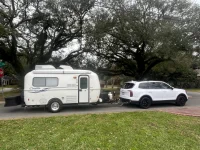
I currently have a Telluride SX Limited Edition AWD 2020 (Canadian version). I ordered it with the tow package and a brake controller (dealer-installed). I also recently bought an RV travel trailer, a Prime Time Tracer Breeze 20RBS 2019. Its dry weight is 4110 lb and hitch weight is 408 lb, sooooo pretty near the Telluride's documented limits (5000 and 500). I also bought a high-end Husky Centerline TS torsion bar kit.
So far we have made two mountain-bike-specific trips with the RV
Self-leveling suspension MUST be taken under account though, when initially moving with the RV. With that kind of weight, suspension is initially quite low, and so if there are any obstacles in the driveway, on the campground roads or wherever in the first mile, extra care must be taken not to hit the bottom part of the ball mount or the trailer's jack. I learned this the hard way when pulling out of a driveway the first week, which had tire tracks that were lower than the middle part of the dirt driveway. Fortunately no damage to the Telluride or the RV, just the driveway.. After a bit of driving, the self-leveling suspension does its magic and the Telluride levels out.
As far as weight management is concerned, I try to only move with empty black and grey tanks, and only a bit of water in the fresh water tank for on-the-road bathroom breaks. I have had to drive a few dozen miles with nearly-full black, gray and fresh water tanks to reach a dumping spot; the added weight was apparent, but driving was still perfectly fine. Otherwise, our bikes are stored in the Telluride, and our luggage spread throughout the RV. The heaviest moving piece of luggage we have is a kind of storage ottoman we use as a pantry; it is placed above the RV's axles when moving.
On the road, I use Sports Mode, which helps a lot with varying engine needs depending on road conditions. Sometimes it will stay in a smaller gear a bit too long for my taste on a flat road, and so I'll occasionally go to a gear higher (in manual) and go back to automatic, and it'll usually stay that way until the road goes up again. I disable auto-start/stop, as well as the side sensors because they usually go off with the trailer attached. I do NOT turn on auto-hold, as the trailer's breaks wouldn't activate. I also deactivated the automatic liftgate, to avoid accidentally opening the gate while the RV is attached (the door won't clear the power jack).
I initially tried installing snap-on mirror extensions to get a better view behind me, but even with the extensions, I found my view was quite limited. I bought a wireless camera system with the RV, but the dealer installed it pointing down to get a good view of the rear bumper (to make sure I don't hit anything backing up at a campground I guess); but once I figured I could have it point higher and see everything on the road behind me, I got used to using it as a mirror. And so I haven't used by snap-on mirrors at all during the two trips.
I use cruise-control a lot, and I found its lane keep assist is quite useful/pleasant when driving with wind. I leave the adaptive cruise control ON (at the longest distance possible), and it works great for adapting to slight traffic speed changes. But if a rather abrupt speed decrease is needed (any slow-down which I know will use the Telluride's breaks), I use the break pedal to disengage the adapting cruise control and activate the trailer's breaks as well.
So far I have driven under rather strong winds (from all directions), and also with pouring rain (to the point where visibility was an issue). No problems at all with the heavy trailer. The anti-sway seems to do its job remarkably. I've had to emergency break twice during the two trips, and it both occasions everything went fine.
I was a bit worried boarding the fairy with the trailer, as we parked for a few hours before boarding and I wasn't sure about the self-leveling suspension. The fairy's gate is usually a bit low, and I was worried I'd hit it with the bottom of the torsion bar kit's ball mount (which is VERY low), but boarding slowly and it went it fine.
As for gas milage... as expected, it drinks a lot. I got about 20 to 22 liters per 100 km (10 to 11 miles per gallon). Seems a lot, but it was expected and we take it into account in our trip budget. It's well worth it, just to have the pleasure to have our Telluride in vacation. The "miles remaining" indication in the dashboard must be ignored though, as it cannot know about the added weight in tow, and so is completely inaccurate. I usually divided it mentally by two just to get a better rough estimate of fuel remaining, but after having reached a gas station with only about a gallon left in the tank, I made sure to fill up regularly before reaching half a tank.
That is it for my own personal experience! I knew I was getting a rather heavy RV trailer for the Telluride, but I'm pleased with the results! Can't wait for the next trip!
I currently have a Telluride SX Limited Edition AWD 2020 (Canadian version). I ordered it with the tow package and a brake controller (dealer-installed). I also recently bought an RV travel trailer, a Prime Time Tracer Breeze 20RBS 2019. Its dry weight is 4110 lb and hitch weight is 408 lb, sooooo pretty near the Telluride's documented limits (5000 and 500). I also bought a high-end Husky Centerline TS torsion bar kit.
So far we have made two mountain-bike-specific trips with the RV
- a 2000 km trip (1240 miles), which included countless roads that went up and down, as well as a fairy to cross the St-Lawrence river!
- a 450 km trip (280 miles), which included crossing several very narrow / unpaved construction sites along the way
Self-leveling suspension MUST be taken under account though, when initially moving with the RV. With that kind of weight, suspension is initially quite low, and so if there are any obstacles in the driveway, on the campground roads or wherever in the first mile, extra care must be taken not to hit the bottom part of the ball mount or the trailer's jack. I learned this the hard way when pulling out of a driveway the first week, which had tire tracks that were lower than the middle part of the dirt driveway. Fortunately no damage to the Telluride or the RV, just the driveway..
After a bit of driving, the self-leveling suspension does its magic and the Telluride levels out.As far as weight management is concerned, I try to only move with empty black and grey tanks, and only a bit of water in the fresh water tank for on-the-road bathroom breaks. I have had to drive a few dozen miles with nearly-full black, gray and fresh water tanks to reach a dumping spot; the added weight was apparent, but driving was still perfectly fine. Otherwise, our bikes are stored in the Telluride, and our luggage spread throughout the RV. The heaviest moving piece of luggage we have is a kind of storage ottoman we use as a pantry; it is placed above the RV's axles when moving.
On the road, I use Sports Mode, which helps a lot with varying engine needs depending on road conditions. Sometimes it will stay in a smaller gear a bit too long for my taste on a flat road, and so I'll occasionally go to a gear higher (in manual) and go back to automatic, and it'll usually stay that way until the road goes up again. I disable auto-start/stop, as well as the side sensors because they usually go off with the trailer attached. I do NOT turn on auto-hold, as the trailer's breaks wouldn't activate. I also deactivated the automatic liftgate, to avoid accidentally opening the gate while the RV is attached (the door won't clear the power jack).
I initially tried installing snap-on mirror extensions to get a better view behind me, but even with the extensions, I found my view was quite limited. I bought a wireless camera system with the RV, but the dealer installed it pointing down to get a good view of the rear bumper (to make sure I don't hit anything backing up at a campground I guess); but once I figured I could have it point higher and see everything on the road behind me, I got used to using it as a mirror. And so I haven't used by snap-on mirrors at all during the two trips.
I use cruise-control a lot, and I found its lane keep assist is quite useful/pleasant when driving with wind. I leave the adaptive cruise control ON (at the longest distance possible), and it works great for adapting to slight traffic speed changes. But if a rather abrupt speed decrease is needed (any slow-down which I know will use the Telluride's breaks), I use the break pedal to disengage the adapting cruise control and activate the trailer's breaks as well.
So far I have driven under rather strong winds (from all directions), and also with pouring rain (to the point where visibility was an issue). No problems at all with the heavy trailer. The anti-sway seems to do its job remarkably. I've had to emergency break twice during the two trips, and it both occasions everything went fine.
I was a bit worried boarding the fairy with the trailer, as we parked for a few hours before boarding and I wasn't sure about the self-leveling suspension. The fairy's gate is usually a bit low, and I was worried I'd hit it with the bottom of the torsion bar kit's ball mount (which is VERY low), but boarding slowly and it went it fine.
As for gas milage... as expected, it drinks a lot. I got about 20 to 22 liters per 100 km (10 to 11 miles per gallon). Seems a lot, but it was expected and we take it into account in our trip budget. It's well worth it, just to have the pleasure to have our Telluride in vacation. The "miles remaining" indication in the dashboard must be ignored though, as it cannot know about the added weight in tow, and so is completely inaccurate. I usually divided it mentally by two just to get a better rough estimate of fuel remaining, but after having reached a gas station with only about a gallon left in the tank
, I made sure to fill up regularly before reaching half a tank.That is it for my own personal experience! I knew I was getting a rather heavy RV trailer for the Telluride, but I'm pleased with the results! Can't wait for the next trip!

 We arrived at the dock two and a half hours before the next scheduled departure, and we got the very last spot reserved for RVs/travel trailers! This gave us some time to watch a few whales pass by the pier, and watch a movie