• Hint: Use a descriptive title for your new message
    If you're looking for help and want to draw people in who can assist you, use a descriptive subject title when posting your message. In other words, "I need help with my SUV" could be about anything and can easily be overlooked by people who can help. However, "I need help with my transmission" will draw interest from people who can help with a transmission specific issue. Be as descriptive as you can. Please also post in the appropriate forum. The "Lounge" is for introducing yourself. If you need help with your leather interior, please post in the Interior section - and so on... This message can be closed by clicking the X in the top right corner.
  • Car enthusiast? Join us on Cars Connected! iOS | Android | Desktop

My experience towing a heavy RV travel trailer

sype

Member
Joined
Dec 5, 2019
Messages
38
Reaction score
49
Points
18
Location
Montreal (Quebec, Canada)
Disclaimer: describing my own personal experience... results may vary ;)

I currently have a Telluride SX Limited Edition AWD 2020 (Canadian version). I ordered it with the tow package and a brake controller (dealer-installed). I also recently bought an RV travel trailer, a Prime Time Tracer Breeze 20RBS 2019. Its dry weight is 4110 lb and hitch weight is 408 lb, sooooo pretty near the Telluride's documented limits (5000 and 500). I also bought a high-end Husky Centerline TS torsion bar kit.

So far we have made two mountain-bike-specific trips with the RV
  1. a 2000 km trip (1240 miles), which included countless roads that went up and down, as well as a fairy to cross the St-Lawrence river!
  2. a 450 km trip (280 miles), which included crossing several very narrow / unpaved construction sites along the way
Hooking up the RV to the Telluride has become quite easy with practice. Installing the torsion bar kit is made easier with the power jack, which can quickly raise the hooked-up Telluride to a point where the torsion bars are much easier to seat in their holder. I do all the connections, and my wife double-checks.

Self-leveling suspension MUST be taken under account though, when initially moving with the RV. With that kind of weight, suspension is initially quite low, and so if there are any obstacles in the driveway, on the campground roads or wherever in the first mile, extra care must be taken not to hit the bottom part of the ball mount or the trailer's jack. I learned this the hard way when pulling out of a driveway the first week, which had tire tracks that were lower than the middle part of the dirt driveway. Fortunately no damage to the Telluride or the RV, just the driveway.. 😅 After a bit of driving, the self-leveling suspension does its magic and the Telluride levels out.

As far as weight management is concerned, I try to only move with empty black and grey tanks, and only a bit of water in the fresh water tank for on-the-road bathroom breaks. I have had to drive a few dozen miles with nearly-full black, gray and fresh water tanks to reach a dumping spot; the added weight was apparent, but driving was still perfectly fine. Otherwise, our bikes are stored in the Telluride, and our luggage spread throughout the RV. The heaviest moving piece of luggage we have is a kind of storage ottoman we use as a pantry; it is placed above the RV's axles when moving.

On the road, I use Sports Mode, which helps a lot with varying engine needs depending on road conditions. Sometimes it will stay in a smaller gear a bit too long for my taste on a flat road, and so I'll occasionally go to a gear higher (in manual) and go back to automatic, and it'll usually stay that way until the road goes up again. I disable auto-start/stop, as well as the side sensors because they usually go off with the trailer attached. I do NOT turn on auto-hold, as the trailer's breaks wouldn't activate. I also deactivated the automatic liftgate, to avoid accidentally opening the gate while the RV is attached (the door won't clear the power jack).

I initially tried installing snap-on mirror extensions to get a better view behind me, but even with the extensions, I found my view was quite limited. I bought a wireless camera system with the RV, but the dealer installed it pointing down to get a good view of the rear bumper (to make sure I don't hit anything backing up at a campground I guess); but once I figured I could have it point higher and see everything on the road behind me, I got used to using it as a mirror. And so I haven't used by snap-on mirrors at all during the two trips.

I use cruise-control a lot, and I found its lane keep assist is quite useful/pleasant when driving with wind. I leave the adaptive cruise control ON (at the longest distance possible), and it works great for adapting to slight traffic speed changes. But if a rather abrupt speed decrease is needed (any slow-down which I know will use the Telluride's breaks), I use the break pedal to disengage the adapting cruise control and activate the trailer's breaks as well.

So far I have driven under rather strong winds (from all directions), and also with pouring rain (to the point where visibility was an issue). No problems at all with the heavy trailer. The anti-sway seems to do its job remarkably. I've had to emergency break twice during the two trips, and it both occasions everything went fine.

I was a bit worried boarding the fairy with the trailer, as we parked for a few hours before boarding and I wasn't sure about the self-leveling suspension. The fairy's gate is usually a bit low, and I was worried I'd hit it with the bottom of the torsion bar kit's ball mount (which is VERY low), but boarding slowly and it went it fine.

As for gas milage... as expected, it drinks a lot. I got about 20 to 22 liters per 100 km (10 to 11 miles per gallon). Seems a lot, but it was expected and we take it into account in our trip budget. It's well worth it, just to have the pleasure to have our Telluride in vacation. The "miles remaining" indication in the dashboard must be ignored though, as it cannot know about the added weight in tow, and so is completely inaccurate. I usually divided it mentally by two just to get a better rough estimate of fuel remaining, but after having reached a gas station with only about a gallon left in the tank 😅, I made sure to fill up regularly before reaching half a tank.

That is it for my own personal experience! I knew I was getting a rather heavy RV trailer for the Telluride, but I'm pleased with the results! Can't wait for the next trip!
 
Great write up - thanks! I'll be hauling much less: 2 motorcycles on a low trailer which will be under 2,000 lbs. total. Still, it's great to know the Telluride can handle towing up to its rated load as expected.
 
Nice write up! Also glad to hear the self leveling shocks worked under this load. I hope they keep working for you. Great advice to take it slow! Please keep posting on your findings.
 
Last edited:
Thanks for the great write up! Which ferry did you take? We recently rented an RV and took the St. Simeon ferry in a 26' RV. It was fun!

I just purchased a Canadian (from Ottawa) 2022 SX Nightsky in Everlasting Grey. ETA late October.

A few questions for you:

I'm planning on buying a trailer. Should I get the dealer installed tow hitch or buy an aftermarket one? If aftermarket, which one do you use?

Any issues/concerns with transmission temps? I've read that there's uncertainty whether the Tellurides come with or without a transmission cooler, and if they do whether it's heavy duty enough to handle a trailer close to 5,000#.
______________________________
 
Thanks for the great write up! Which ferry did you take? We recently rented an RV and took the St. Simeon ferry in a 26' RV. It was fun!

I just purchased a Canadian (from Ottawa) 2022 SX Nightsky in Everlasting Grey. ETA late October.

A few questions for you:

I'm planning on buying a trailer. Should I get the dealer installed tow hitch or buy an aftermarket one? If aftermarket, which one do you use?

Any issues/concerns with transmission temps? I've read that there's uncertainty whether the Tellurides come with or without a transmission cooler, and if they do whether it's heavy duty enough to handle a trailer close to 5,000#.

We took that same Saint-Siméon to Rivière-du-Loup ferry :) We arrived at the dock two and a half hours before the next scheduled departure, and we got the very last spot reserved for RVs/travel trailers! This gave us some time to watch a few whales pass by the pier, and watch a movie :)

I'm also swapping my 2020 Telluride for a 2022 SX Limited Nightsky edition, but in Wolf Grey. Same general ETA.

As for your question regarding which hitch to buy, I really couldn't say. I just added it to my initial order at the Kia dealership, but I didn't investigate if I'd be better off with an aftermarket one.. I pretty much did the same thing with my 2022 order.

And regarding transmission temperature, I haven't had any issue, and I haven't measured it either, so I couldn't really tell.. I did a 11-hours drive the last day of our trip to get back home, and I didn't notice any issue (would I have? I don't know much in this area, admittedly).
 
We took that same Saint-Siméon to Rivière-du-Loup ferry :) We arrived at the dock two and a half hours before the next scheduled departure, and we got the very last spot reserved for RVs/travel trailers! This gave us some time to watch a few whales pass by the pier, and watch a movie :)

I'm also swapping my 2020 Telluride for a 2022 SX Limited Nightsky edition, but in Wolf Grey. Same general ETA.

As for your question regarding which hitch to buy, I really couldn't say. I just added it to my initial order at the Kia dealership, but I didn't investigate if I'd be better off with an aftermarket one.. I pretty much did the same thing with my 2022 order.

And regarding transmission temperature, I haven't had any issue, and I haven't measured it either, so I couldn't really tell.. I did a 11-hours drive the last day of our trip to get back home, and I didn't notice any issue (would I have? I don't know much in this area, admittedly).
We did almost the same. We arrived a few hours early, grabbed some poutine from the restaurant and tried to whale watch, but ended up throwing rocks into the water (our kids favourite thing to do there!).

The dealer I'm buying from said that the Kia hitch is apparently only rated to 3,500 lbs, and that they would need a 3rd party to install the 5,000 lbs hitch. This is confusing for me... why would Kia sell a hitch rated lower than the towing limit of the vehicle! This is all new to me, so want to ensure I'm doing the right thing to be able to tow safely!
 
The dealer I'm buying from said that the Kia hitch is apparently only rated to 3,500 lbs, and that they would need a 3rd party to install the 5,000 lbs hitch.

The dealer you are attempting to buy from from doesn't understand the current Telluride specs. Here's the kia.ca site for downloading the manual: Kia Cars Owners | Car Owners Manual | Kia Canada In the PDF for the 2021 Kia Telluride on page 5-149 the maximum tongue weight is 227kg (or 500lbs).

Early in 2019 the manual stated that the maximum tongue weight was 351 lbs. By most safety recommendations the tongue weight should not exceed 10% of the towing weight. So that would make the max 3,500 lbs. Kia issued a correction to the manual in October 2019 and since changed it in new manuals to 500 lbs. this way you can tow up to 5,000 lbs and still remain within spec. Kia also changed from a 4-pin to a 7-pin harness in the US, you typically don't need a 7-pin harness and a brake controller if you are towing something under 3,000 lbs. I'm not sure if the 7-pin round harness from Kia is available in the Kia Tow Option or Tow Package from Canada, but if not you can probably buy it online from a US dealer.

Maybe that dealer is also referencing the pricing from early in 2019 as well and that will work to your benefit? Towable RV sales in the US have hit all time highs since the start of the pandemic. Dealers should really try to understand their customers needs when buying an SUV.
 
Last edited:
The dealer you are attempting to buy from from doesn't understand the current Telluride specs. Here's the kia.ca site for downloading the manual: Kia Cars Owners | Car Owners Manual | Kia Canada In the PDF for the 2021 Kia Telluride on page 5-149 the maximum tongue weight is 227kg (or 500lbs).

Early in 2019 the manual stated that the maximum tongue weight was 351 lbs. By most safety recommendations the tongue weight should not exceed 10% of the towing weight. So that would make the max 3,500 lbs. Kia issued a correction to the manual in October 2019 and since changed it in new manuals to 500 lbs. this way you can tow up to 5,000 lbs and still remain within spec. Kia also changed from a 4-pin to a 7-pin harness in the US, you typically don't need a 7-pin harness and a brake controller if you are towing something under 3,000 lbs. I'm not sure if the 7-pin round harness from Kia is available in the Kia Tow Option or Tow Package, but if not you can probably buy it online from a US dealer.

Maybe that dealer is also referencing the pricing from early in 2019 as well and that will work to your benefit? Towable RV sales in the US have hit all time highs since the start of the pandemic. Dealers should really try to understand their customers needs when buying an SUV.
Yes, that could be the case. I sent them an email to clarify what is going on. If I can get a 7 pin wiring harness with brake controller installed for my delivery date, that would be perfect as it would then be covered by the factory warranty. I'm buying an RV from a dealer the specializing in towing and they have a weight distribution hitch they can install when I take delivery of the RV.
______________________________
 
Your dealer doesn't seem to be very knowledgeable, so I would be very careful with what he does. Do you want the Kia hitch installed or an after market hitch? The Kia hitch is mounted higher and requires changing part of the bumper trim piece to accommodate the Kia hitch. Also, probably more expensive that ordering from the factory. After market hitch is cheaper, but hangs below the bumper. Your RV dealer might do a better job than the Kia dealer for an after market hitch.

See what others have done. Hitch Install ... Dealer vs Aftermarket
 
I've got a Canadian (from Ottawa) 2022 Telluride on order for delivery in late October. Dealer is quoting me $1,599 + taxes to install the Kia trailer hitch, and an aftermarket 7 pin harness. Seems expensive! Is this in line with what others have paid? Thanks
 
I've got a Canadian (from Ottawa) 2022 Telluride on order for delivery in late October. Dealer is quoting me $1,599 + taxes to install the Kia trailer hitch, and an aftermarket 7 pin harness. Seems expensive! Is this in line with what others have paid? Thanks

Seems a LOT! I don't remember what I paid for my 2020, but for my 2022, it's coming in with a Hitch, 7-pin harness and break controller for CAD$980+tx..
 
Reopening an older but relevant thread, we too tow a heavy camper trailer: Lance 1685 (16ft). Of the 14,000 miles on our '21 almost 5000 miles of it has been towing the camper. The WDH w/ Anti sway is a MUST. The camper dealer installed the Husky Centerline when we first picked up the camper. The WDH does wonders in leveling the rigs with the addition on the Telly's factory tow package. I've never experienced a road clearance issue with the WDH from initial takeoff before the levelling system adjusts. The Telly tows beautifully finding the right sweet spot gear in the 8 speed. It seems to like #6 for steady flat cruising but it quickly adjusts up or down on any grades. I've never had a cooling issue. I usually stay about 60-63mph on highways, even with 75 mph speed limits. In strong head winds, I go even slower as fuel mileage suffers. While towing I seem to average about 12 mpg. I tried side mirror extensions but they didn't seem to help much.
The remaining fuel mileage indicator is not that accurate. The last half of the tank really goes fast. The MPG consumption read out is the most accurate indicator and it's easy to do the math on real mileage left.
For anyone considering a camper purchase go online and find the brand's online forum. There will be tons of valuable information from owners. Pay very close attention to the trailer's weight and tongue weight. You will ALWAYS exceed what the manufacturer lists as they use DRY weights which do not include much of what most would consider standard weight like batteries, propane, solar panels, awnings, etc. Plus there's all your stuff! Keep your Telly happy.
______________________________
 
Noticed about 4 days before a big camping trip that the OEM hitch had a rust hole on the back side, found this CURT travel trailer hitch for a really good price and was the next class up from what my OEM hitch was. Rec it pretty fast considering the size and weight. It can tow my family camper, bike rack, horse trailer, and boat. It is safe and reliable.
 
We did almost the same. We arrived a few hours early, grabbed some poutine from the restaurant and tried to whale watch, but ended up throwing rocks into the water (our kids favourite thing to do there!).

The dealer I'm buying from said that the Kia hitch is apparently only rated to 3,500 lbs, and that they would need a 3rd party to install the 5,000 lbs hitch. This is confusing for me... why would Kia sell a hitch rated lower than the towing limit of the vehicle! This is all new to me, so want to ensure I'm doing the right thing to be able to tow safely!
Must be a fun outing As for the hitch, it's odd indeed. Have you checked with Kia directly about this discrepancy?
 
Disclaimer: describing my own personal experience... results may vary ;)

I currently have a Telluride SX Limited Edition AWD 2020 (Canadian version). I ordered it with the tow package and a brake controller (dealer-installed). I also recently bought an RV travel trailer, a Prime Time Tracer Breeze 20RBS 2019. Its dry weight is 4110 lb and hitch weight is 408 lb, sooooo pretty near the Telluride's documented limits (5000 and 500). I also bought a high-end Husky Centerline TS torsion bar kit.

So far we have made two mountain-bike-specific trips with the RV
  1. a 2000 km trip (1240 miles), which included countless roads that went up and down, as well as a fairy to cross the St-Lawrence river!
  2. a 450 km trip (280 miles), which included crossing several very narrow / unpaved construction sites along the way
Hooking up the RV to the Telluride has become quite easy with practice. Installing the torsion bar kit is made easier with the power jack, which can quickly raise the hooked-up Telluride to a point where the torsion bars are much easier to seat in their holder. I do all the connections, and my wife double-checks.

Self-leveling suspension MUST be taken under account though, when initially moving with the RV. With that kind of weight, suspension is initially quite low, and so if there are any obstacles in the driveway, on the campground roads or wherever in the first mile, extra care must be taken not to hit the bottom part of the ball mount or the trailer's jack. I learned this the hard way when pulling out of a driveway the first week, which had tire tracks that were lower than the middle part of the dirt driveway. Fortunately no damage to the Telluride or the RV, just the driveway.. 😅 After a bit of driving, the self-leveling suspension does its magic and the Telluride levels out.

As far as weight management is concerned, I try to only move with empty black and grey tanks, and only a bit of water in the fresh water tank for on-the-road bathroom breaks. I have had to drive a few dozen miles with nearly-full black, gray and fresh water tanks to reach a dumping spot; the added weight was apparent, but driving was still perfectly fine. Otherwise, our bikes are stored in the Telluride, and our luggage spread throughout the RV. The heaviest moving piece of luggage we have is a kind of storage ottoman we use as a pantry; it is placed above the RV's axles when moving.

On the road, I use Sports Mode, which helps a lot with varying engine needs depending on road conditions. Sometimes it will stay in a smaller gear a bit too long for my taste on a flat road, and so I'll occasionally go to a gear higher (in manual) and go back to automatic, and it'll usually stay that way until the road goes up again. I disable auto-start/stop, as well as the side sensors because they usually go off with the trailer attached. I do NOT turn on auto-hold, as the trailer's breaks wouldn't activate. I also deactivated the automatic liftgate, to avoid accidentally opening the gate while the RV is attached (the door won't clear the power jack).

I initially tried installing snap-on mirror extensions to get a better view behind me, but even with the extensions, I found my view was quite limited. I bought a wireless camera system with the RV, but the dealer installed it pointing down to get a good view of the rear bumper (to make sure I don't hit anything backing up at a campground I guess); but once I figured I could have it point higher and see everything on the road behind me, I got used to using it as a mirror. And so I haven't used by snap-on mirrors at all during the two trips.

I use cruise-control a lot, and I found its lane keep assist is quite useful/pleasant when driving with wind. I leave the adaptive cruise control ON (at the longest distance possible), and it works great for adapting to slight traffic speed changes. But if a rather abrupt speed decrease is needed (any slow-down which I know will use the Telluride's breaks), I use the break pedal to disengage the adapting cruise control and activate the trailer's breaks as well.

So far I have driven under rather strong winds (from all directions), and also with pouring rain (to the point where visibility was an issue). No problems at all with the heavy trailer. The anti-sway seems to do its job remarkably. I've had to emergency break twice during the two trips, and it both occasions everything went fine.

I was a bit worried boarding the fairy with the trailer, as we parked for a few hours before boarding and I wasn't sure about the self-leveling suspension. The fairy's gate is usually a bit low, and I was worried I'd hit it with the bottom of the torsion bar kit's ball mount (which is VERY low), but boarding slowly and it went it fine.

As for gas milage... as expected, it drinks a lot. I got about 20 to 22 liters per 100 km (10 to 11 miles per gallon). Seems a lot, but it was expected and we take it into account in our trip budget. It's well worth it, just to have the pleasure to have our Telluride in vacation. The "miles remaining" indication in the dashboard must be ignored though, as it cannot know about the added weight in tow, and so is completely inaccurate. I usually divided it mentally by two just to get a better rough estimate of fuel remaining, but after having reached a gas station with only about a gallon left in the tank 😅, I made sure to fill up regularly before reaching half a tank.

That is it for my own personal experience! I knew I was getting a rather heavy RV trailer for the Telluride, but I'm pleased with the results! Can't wait for the next trip!
I realize this is old but I just came across this. I have the same setup with my 22 SX-L and a 22ft Gulfstream at 3800 lbs dry. With the same hitch, my setup seems to sag a little (not as level as yours). Can you tell me if your ball is mounted at the top of the hitch or not? Mine is. Or, do you have pics you can provide?
 
Nice story! Do you still have the Telluride?
I really enjoyed reading about your towing experience. I’m curious if you’ve taken any more long trips since then and whether you’ve run into any issues with the Telluride over time—especially with towing. Would love to hear any updates!
______________________________
 
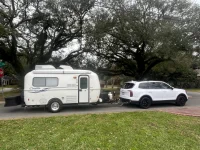
We just returned from a 1000 mile round trip from Louisiana to Texas for a fiberglass RV rally pulling our Casita trailer which is only 3200 lbs. wet.

It pulls it really nice, don't need mirror extensions and it got right at 16mpg running 65-70 mph (all interstate except the final 10 miles to the campground)

We have the tow mode on the EX-X Pro which I think is equivalent to sport mode and it does level the rear end out slightly after driving a short distance.

There were several Tellurides and also several Hyundai Palisade that tow the same trailer, all were extremely pleased with the towing experience, some used weight distribution hitches (Andersen) and some only used a small sway bar.
 

Attachments

  • test-ride.webp
    test-ride.webp
    525.5 KB · Views: 6
We did a 3500mi (+) trip from MI to Oregon, Cali, Utah, and S. Dakota in our 2020 EX with tow hitch and Shocks in '23. We pulled Gulfstream 19DD (3200# dry). The Telly did well with one exception during a pretty rugged climb on I-90 into a stiff Wyoming headwind (20mph?) above 7000 feet altitude. The car felt like it wanted to die and mileage dropped to near 6mpg... but that was early in the trip and the car recovered well. The Gulfstream I wide with corrugated front valence so not very aerodynamic. We also didn't have WDH but never a problem (a bit squashed but never bottomed out.
This summer we'll do another 4000 miles to Yellowstone and thereabouts but in a newer Jayco Micro 171bh, a WDH (Andersen), and new spark plugs, brakes, trans and coolant flush. Good times!


Back
Top